Is Your Child a "Digital Zombie"? The Critical Difference Between Passive and Active Screen Time
Is your child hypnotized in front of the tablet or learning? The harms of passive screen time, "Video Deficiency," and a guide to active learning with Lume.
Escape from "Zombie Mode" in Screen Time: From Passive Consumption to Active Production
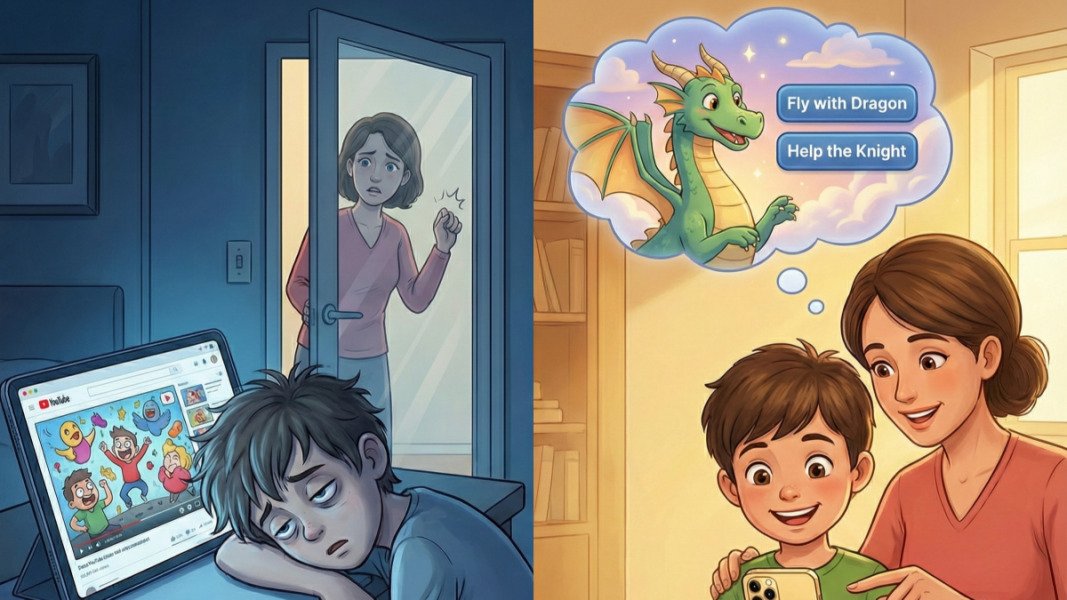
When you enter the room, you see this scene: Your child is in front of a tablet, mouth slightly open, staring at the screen without blinking. When you call out, they don't hear you, as if they've entered another dimension... This situation, known among parents as "zombie mode," is one of the most common worries of the modern age.
Today's children, called "Digital Natives," complete the most critical stages of their cognitive and emotional development in an ecosystem dominated by screens. But don't worry; not all screen time is the enemy. Scientific research shows that the real problem is not the technology itself but the way it is integrated (modality) [2, 3].
So, is your child really learning while looking at the screen, or just hypnotized? The answer lies in the fine line between Passive and Active use.
"Toxic" Screen Time: What is Passive Consumption?
The most critical distinction in the screen time literature is between "passive" and "active" use [3]. Passive screen time refers to situations where the child exerts no cognitive effort and is only in a "receiver" position. Watching videos back-to-back (autoplay) or aimlessly scrolling on social media are the clearest examples.
This type of passive consumption is linked to the brain's "default mode network" and has been observed to increase the risk of attention deficits in children due to overstimulation [5].
The Reality of "Video Deficit" in Babies
The situation is especially sensitive in the 0-2 age period [1]. The phenomenon called "Video Deficit" in the literature refers to the neurological difficulty children under 30 months have in transferring information obtained from two-dimensional screens to the real world [1, 4].
Even if your child perceives the colorful images on the screen, their ability to grasp these as symbolic representations is not yet mature. Therefore, time spent only watching videos does not create the expected educational effect; on the contrary, it may lead to delays in language and social skills.
The Solution is Not to Ban: Transition from Passive Consumption to Active Production
Completely removing screens from our lives is not a practical solution. Scientific data emphasize that the solution is not to "ban" but to "transform" [7]. Our goal is to turn the screen from a passive "watching" tool into an active "experience" tool [3].
When active use comes into play, the child is no longer just a viewer but a decision-maker:
- Deciding the course of a story,
- Answering a question,
- Analyzing a character's emotion...
These actions activate the prefrontal cortex, the brain's most advanced area responsible for logical thinking [4, 6].
Lume Model: Turn Your Child into a Hero
This is exactly where Lume: Tales & Adventures comes in. Lume is designed to transform the time children spend in front of screens from passive video consumption into an interactive and creative experience.
Lume stories are not linear; they frequently offer your child decision points like "What should you do now?" Thanks to this interactive structure:
- Analytical Thinking: The child experiences the consequences of their choices (cause-effect relationships) in a safe simulation environment.
- Impulse Control: Being able to change the flow of the story teaches the child patience and to act thoughtfully.
- Imagination: Since audio storytelling is used instead of visual bombardment, the child imagines characters with their own "mind's eye." This activates the brain's visualization centers more than watching animations [6].
Conclusion: Quality is More Important Than Quantity
Our ultimate advice for families is this: Don't just count screen time in "minutes"; focus on the "quality" of the content and your child's "neurological response" [2, 7].
Will the tablet be a "digital pacifier" for your child or a "toolbox" that nurtures their creativity? The choice is yours. If you are ready to turn your child from a passive viewer into the hero of their own story, you are invited to the world of Lume.
Download Lume from the App Store
References and Sources
The information in this article is based on reports from the American Academy of Pediatrics (AAP) and global neurobiological research. You can access the relevant academic sources below:
- Screen Time for Infants - AAP: https://www.aap.org/en/patient-care/media-and-children/center-of-excellence-on-social-media-and-youth-mental-health/qa-portal/qa-portal-library/qa-portal-library-questions/screen-time-for-infants/
- Are some types of screen time better than others? - Children and Screens: https://www.childrenandscreens.org/learn-explore/research/are-some-types-of-screen-time-better-than-others/
- Active vs passive screen time - The Voice Of Early Childhood: https://thevoiceofearlychildhood.com/active-vs-passive-screen-time/
- Effects of Screen Time on Children's Brain Development: https://scholarlycommons.pacific.edu/pjh/vol6/iss1/14/
- Screen Time and the Developing Brain: Are 'iPad Kids' at Risk? - URMC: https://www.urmc.rochester.edu/news/publications/health-matters/screen-time-and-the-developing-brain-are-ipad-kids-at-risk
- Effects of storytelling on the childhood brain (NIRS Study) - NIH: https://pmc.ncbi.nlm.nih.gov/articles/PMC6305786/
- Kids & Screen Time: How to Use the 5 C's of Media Guidance: https://www.healthychildren.org/English/family-life/Media/Pages/kids-and-screen-time-how-to-use-the-5-cs-of-media-guidance.aspx