
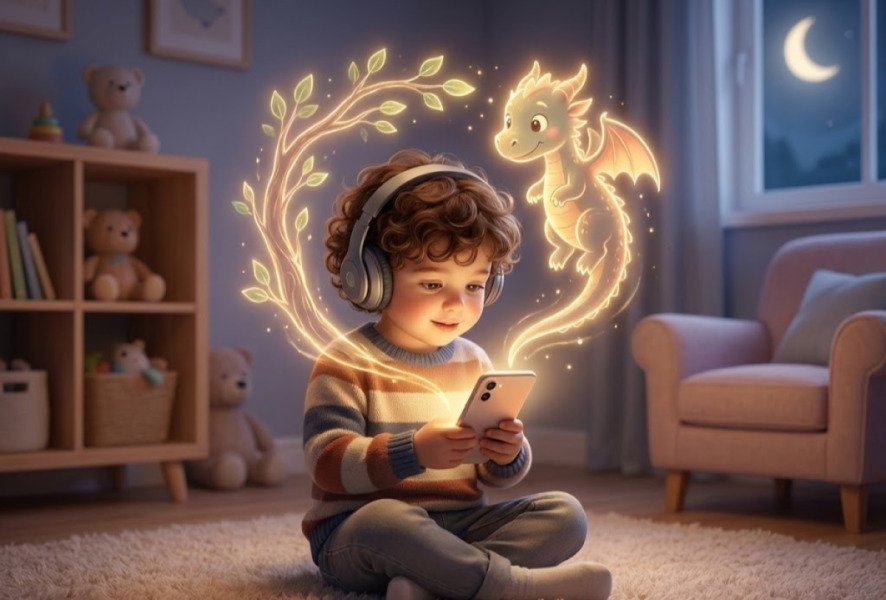
Self-Reference Effect (SRE): Accelerate Learning with Personalized Stories
Why does your child react immediately when they hear their name in a crowded place? Science calls this the "Cocktail Party Effect." Discover how you can boost your child's learning speed and memory with Lume by combining this neurological reflex with the "Self-Reference Effect" (SRE).
The Connection Between the "Cocktail Party Effect" and Learning
Have you ever been at a noisy, crowded party? You ignore the background hum of hundreds of people talking. But the moment someone across the room whispers your name, your brain filters out all other sounds and focuses only on that voice. In science, this is called the "Cocktail Party Effect".
What if we told you this neurological reflex is one of the strongest tools for your child's education and development?
Your child's brain uses the concept of "Self" as a filter while trying to handle a world full of environmental stimuli. If the incoming information (a story, a lesson, or a word) is directly related to them, their name, or things they love; the brain sends the signal "Pay attention, this information is about you!" This is exactly the scientific secret behind the Lume: Tales & Adventures app.
Neuroscience's Holy Grail: Self-Reference Effect (SRE)
Educators have been researching for years how to teach information with the least effort and the most lasting effect. The answer lies in the "Self-Reference Effect" (SRE), proven by neuroscience research.
Studies show that children process and store information related to themselves much more deeply than standard information. While a child is a passive listener in a regular story, in a personalized story, a strong neural highway is formed between the brain's Medial Prefrontal Cortex (mPFC) and the memory center, the Hippocampus.
This means: While your child tries to learn a lesson about someone else by "repeating," they learn a story about themselves by "living it" without extra effort.
Vocabulary and the Miracle of "Fast Mapping"
The most tangible effect of personalized stories is seen in language development. Research by Natalia Kucirkova and her team revealed a striking fact: Children learn new and difficult words much faster in stories that include their own names or familiar objects compared to standard stories.
This is called "Fast Mapping." For example;
-
Standard Story: "The child found a capsule in the forest." (The child might struggle to understand the word "capsule.")
-
Personalized Story with Lume: "[Child's Name] and their cat Pamuk found a shining capsule in the forest."
Because the child catches an autobiographical memory hook like "their own cat Pamuk," they automatically store the nearby word "capsule" in their memory.
Why Just Changing the Name Is Not Enough?
Old-style personalized books worked only on the "Find and Replace" logic. But Lume uses Generative AI to contextually recreate the story.
-
Endowment Effect: The child owns the story as "their own." This increases their motivation to read and listen by 30%.
-
Emotional Simulation: When your child makes a tough decision in the story (e.g., "Should I share?"), it’s not just a game but a character rehearsal in a safe space. The brain records this experience as if it were real.
-
Active Mind’s Eye: Instead of offering ready animations, Lume prefers narration supported by voice and visuals. Your child must imagine the "blue-winged dragon" in their mind, building a bridge between the visual cortex and language centers.
Conclusion: Turn the Screen into a "Mirror"
Technology is often seen as a "window" that disconnects the child from the outside world. However, Lume transforms technology into a "mirror" where the child sees their own self, recognizes their feelings, and develops their vocabulary.
Don't just tell your child a fairy tale; give them their own story as a gift. With this scientifically proven method, you will witness how effortless and fun learning can be.
Turn your child's name into a learning key with Lume: Tales & Adventures.
Download Lume: Tales & Adventures and Discover Personalized Learning
References
This content is compiled from the following scientific studies and academic publications:
-
National Institutes of Health (NIH) - PMC: Self-referential encoding in the developing brain
-
Frontiers in Psychology: Self-Reference and Children's Retention of Novel Words
-
ResearchGate: Reading personalized books with preschool children enhances their word acquisition
-
PubMed: The self-reference effect on memory in early childhood
-
Reach Out and Read: Differences in functional brain network connectivity during stories presented in audio, illustrated, and animated format
-
Wikipedia: Self-reference effect
Related Posts

Why Does Your Child Say "One More Story"? The Hidden Power of Imagination
That tiny bedtime request may be more than a delay tactic. It may be your child asking for connection, imagination, and emotional safety.
Banning Is Not the Solution: The American Academy of Pediatrics' "5C Model" for a Healthy Media Diet
Are you having trouble managing your child's screen time? Instead of strict bans and guilt, meet the American Academy of Pediatrics' (AAP) scientific "5C Model." This guide offers ways to turn technology from a passive consumption tool into an active educational tool that supports your child's brain development.